10 Best AI Tools to Grow Mobile Apps (and How to Combine Them Into One System)
Most growth teams operate with a fragmented tech stack. They have Firebase for analytics, RevenueCat for payments, Braze for messaging, and several creative tools. Each tool provides critical insight, but no single tool provides the execution layer. This fragmentation leads to the "Execution Gap" the costly delay between identifying a problem and deploying a fix. For modern subscription apps, the future belongs not to those with the most data, but to those with the fastest Action Loop. This post outlines the 9 essential AI tools used today and introduces the 10th tool: the App Growth OS the unification layer required to turn isolated insights into automated, compounding growth.

Michael Synowiec
·
6 min read

I. TL;DR Answer Box: The Autonomous Agent Model
Element | Description |
Problem | Owning 10 best AI tools creates 10 points of friction. Data must be unified to enable automated execution. |
Solution | The App Growth OS acts as the 10th tool, the Execution Layer turning fragmented data into safe, automated fixes via SDK. |
Tool Chaos Score (TCS) | TCS = (Number of Tools) x (Average Delay Time in Days) / (Tests Shipped per Month) |
Key Takeaway | Unification and Execution (AppDNA) define the future of mobile growth, not just data collection. |
II. Introduction: Tool Chaos vs. Systemic Execution
Most growth teams operate with a fragmented tech stack. They have Firebase for analytics, RevenueCat for payments, Braze for messaging, and several creative tools. Each tool provides critical insight, but no single tool provides the execution layer.
This fragmentation leads to the "Execution Gap" the costly delay between identifying a problem and deploying a fix. For modern subscription apps, the future belongs not to those with the most data, but to those with the fastest Action Loop.
This post outlines the 9 essential AI tools used today and introduces the 10th tool: the App Growth OS the unification layer required to turn isolated insights into automated, compounding growth.
III. Category 1: AI Tools for Analytics & Measurement (Insight Layer)
These tools are essential for the Audit phase (Audit - Approve - Ship - Learn). They tell you what is broken, but crucially, they do not tell you how to fix it or execute the fix safely and automatically. They provide the 'Diagnosis', but not the 'Surgery'.
Firebase (Google)
Role: Core analytics and crash reporting. Provides robust event tracking necessary for defining key milestones (e.g., the user's "Aha moment").
AI Function: Predictive analytics features use machine learning to segment users likely to churn or purchase. For instance, Firebase might predict that users who skip the onboarding tutorial have a 60% higher chance of churning, but the team still needs an external system to test a mandatory tutorial variant.
AppsFlyer (or Adjust / Singular)
Role: Mobile Attribution Partner (MMP). Essential for measuring marketing effectiveness and understanding where high-value users originate a critical component of the Growth OS's overall optimization strategy.
AI Function: Fraud detection and LTV (Lifetime Value) prediction models help calibrate user acquisition spend.
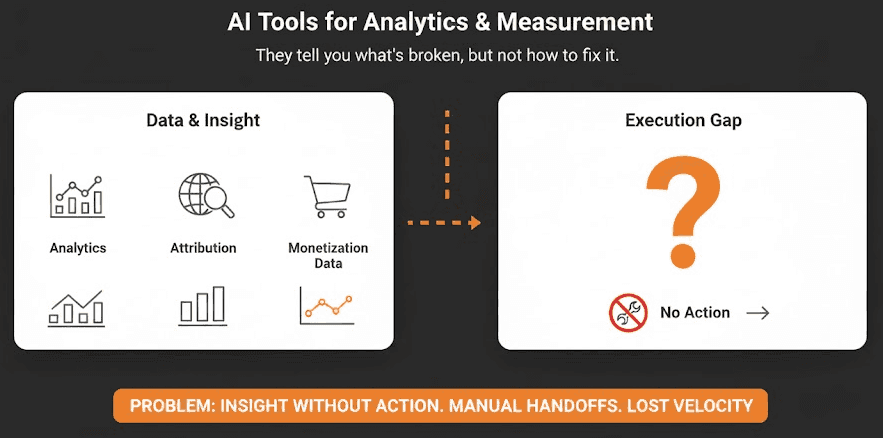
The Execution Gap Closure: The biggest bottleneck in this category is the lack of a native execution layer. The data from these tools must flow directly into the App Growth OS to fuel the AI agent's decision-making process. The OS treats this diagnostic data as the input for its autonomous Approve and Ship phases, instantly closing the gap between insight and measurable improvement.
IV. Category 2: AI Tools for Monetization (Value Capture Layer)
These tools manage the payment infrastructure and pricing intelligence. They flag when a conversion problem exists, but the deployment of pricing changes or paywall shifts is typically manual and slow.

RevenueCat (or Adapty)
Role: Subscription infrastructure. Manages trials, payments, entitlements, and crucial backend monetization data. They serve as the definitive "source of truth" for MRR and user subscription status.
AI Function: Provides advanced analytics on cohort performance and subscription behavior. These tools can flag when a conversion problem exists (e.g., high churn rate in the first month).
The Execution Barrier: Testing new pricing tiers, introducing localized offers, or shifting the paywall layout often requires a new, complex A/B test setup external to the console, followed by a slow coordination process between product and engineering teams.
Price Intelligently (or similar Pricing Intelligence)
Role: External market data and pricing optimization. This intelligence layer provides critical strategic input on willingness-to-pay and competitor pricing.
AI Function: Uses competitive analysis and user segment data to recommend optimized pricing points and tier structures (e.g., identifying the ideal anchor pricing for the German market or determining local pricing per geo).
Closing the Monetization Gap with Automation: Monetization is the area where the Cost of Delay is highest. The App Growth OS uses the logic from these tools (like defining a paywall event or a target price) and automates the execution of pricing and timing experiments via SDK, eliminating the manual testing setup.
V. Category 3: AI Tools for CRM & Messaging (Retention Layer)
5. Braze (or OneSignal / Iterable)
Role: Customer Relationship Management (CRM) and messaging infrastructure. Essential for lifecycle management and multi-channel communication (email, push, in-app messages).
AI Function: Optimized messaging delivery times and dynamic content generation based on user behavior segments.
ICP Example (Education): For an education app, the CRM tool flags users who haven't completed a lesson in 48 hours. The AI Agent then automatically executes an in-app message test promoting a localized, high-performing "Catch Up" prompt (copy generated by LLM, deployed via OS).
6. Appcues (or WalkMe / Pendo)
Role: In-app onboarding and guide creation. Used to reduce friction in the first-time user experience (FTUE).
AI Function: AI recommends optimal sequencing and timing of in-app tutorials based on segment success rates.
VI. Category 4: Creative & Copy (Conversion Layer)
7. Copy.ai (or Jasper / ChatGPT)
Role: Generative AI for marketing copy, headlines, and descriptions.
AI Function: Mass generation of conversion-optimized ad copy variants and ASO descriptions.
Friction Point: These tools create thousands of copy variations, but the manual testing and deployment of these variants is the bottleneck.
8. Zapier (or Custom Scripts)
Role: Automation and integration layer.
Friction Point: Zapier is excellent for moving data between consoles, but cannot perform code-level execution (e.g., changing paywall timing or deploying a feature flag).
9. Headway.ai (or similar Creative Optimization)
Role: Creative testing and optimization, particularly for App Store Optimization (ASO).
AI Function: AI identifies which creative elements drive the highest conversion.
ICP Example (Creative Tools): The tool identifies that screenshots showing the final, shared output of the creative tool convert better than screenshots showing the interface. The AI Agent then automatically deploys ASO test variants via Headway's API to confirm the creative hypothesis.
VII. The Unification Layer: How the App Growth OS Combines These Tools
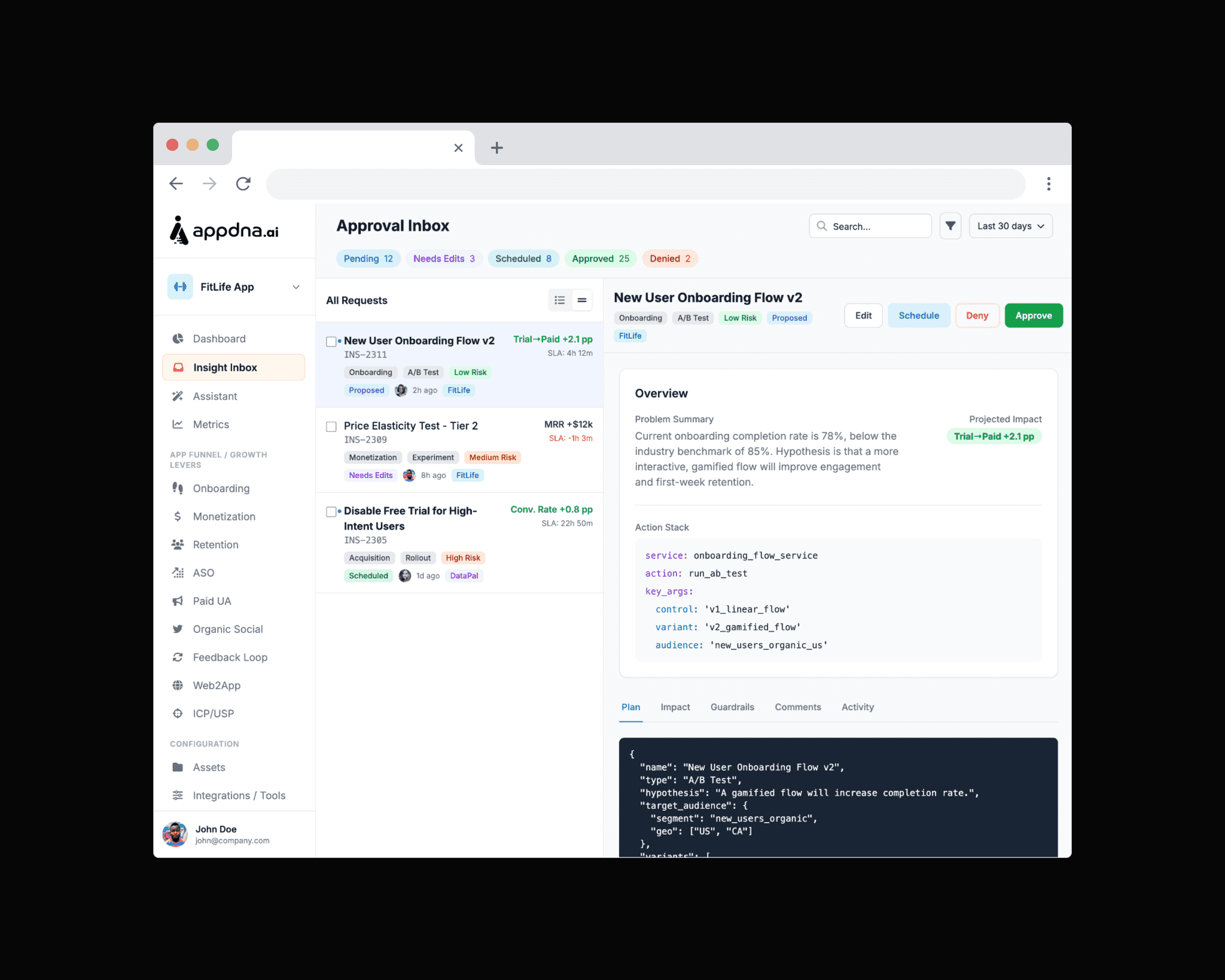
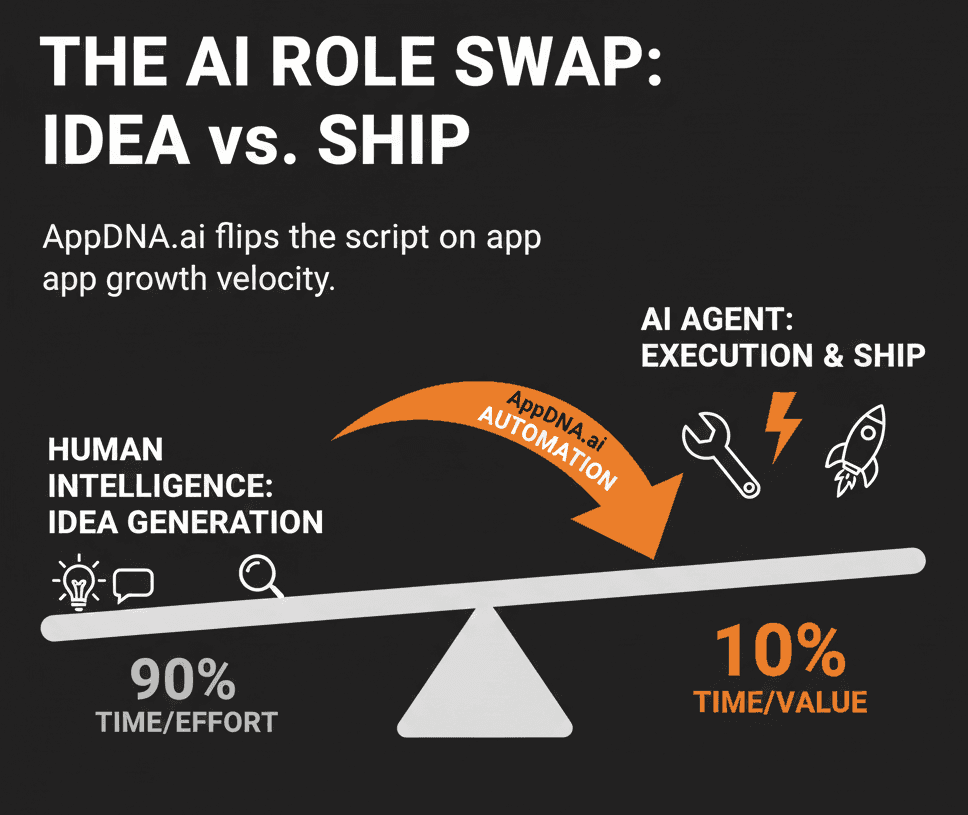
Owning the 9 best tools only creates 9 points of friction. The future of app growth is defined by the 10th tool - the system that unifies and acts. The App Growth OS is your execution layer, acting as a powerful AI agent that consumes insights from your fragmented stack and automatically deploys fixes to your app, safely and without requiring a new app release.
Key Takeaway: The OS treats the data from all tools as inputs for its autonomous Audit → Approve → Ship → Learn loop, enabling true, secure automation. This empowers both agencies and in-house teams to focus on strategy.
End of Post Actionable Elements
Growth Glossary
Term | Definition |
Growth OS | The execution layer that unifies fragmented tools and automates the deployment of growth experiments (fixes) via SDK. |
Execution Layer | The system responsible for autonomously deploying fixes and tests to the live app, minimizing manual engineering effort. |
Traffic Cap | A safety mechanism that limits a new experiment (risk) to a small, contained segment of users (e.g., 5%). |
Instant Rollback | The automatic process of reverting a test or change within minutes if key metrics are negatively affected. |
Value Moment | A key user action that signals high intent or engagement (e.g., finishing the first workout, completing a personalized quiz). |
☑️ Try This Week
Map your current tool stack into the four phases: Audit → Approve → Ship → Learn.
Identify two tools producing insight but suffering from a manual execution gap.
Run your next experiment using a framework that includes traffic caps (Safety).
Add rollback rules to your next feature release (Simplicity).


Everything your app needs to grow. In one system.